A game engine built for an AI game master.

The AI tells the story. WyrdTale makes the world real.

This isn't a ChatGPT wrapper or a prompt with a character sheet attached. WyrdTale is a persistent rules engine the AI operates: it resolves actions, executes skills, applies status effects, runs combat, advances time and weather, and tracks every person, place, faction, item, secret, and relationship across a campaign.

Under the narration

An actual game state is running

You speak naturally. The AI interprets intent and operates WyrdTale's tools; the engine validates the action, rolls the dice, changes durable state, and returns facts the AI must narrate.

You describe an action“Cut across the officer's route and force him into the barrier.”
The AI operates the engineSelects a skill, target, save, and intent through structured game tools.
WyrdTale resolves itChecks legality, rolls, applies effects, updates the world, and returns the outcome.

Kyōsei example: Slipstream Feint

A Linecutter technique from the included Japanese street-punk world. It deals no damage. Instead, a failed Dexterity save applies Thrown Off-Line for a few rounds.

That effect is executable, not flavor text: movement drops 25% and accuracy drops by 2. The same system can grant armor, alter ability scores, give advantage or disadvantage, deal damage over time, scale potency, expire on a clock, and enforce one-effect-per-target rules.

skill: Slipstream Feint pattern: tactical save: Dexterity on_failed_save: apply: Thrown Off-Line status_effect: Thrown Off-Line type: stat_modification duration: three_rounds unique_per_target: true modifiers: movement_speed: -25% accuracy: -2

Real entities from the current Kyōsei starter world, shortened for readability. The world file also defines 19 skills, 9 status effects, 9 classes, 41 developed characters, 36 locations, vehicles, weather rotations, events, relationships, secrets, and live tension clocks.

Your World, From a Conversation

No forms to fill out, no wikis to pre-write. You talk about your world and the engine derives classes, skills, factions, and geography—all consistent with your vision.

Discover Your World
Evocative questions unearth the soul of your setting—its tensions, its history, what makes it alive.
Power Takes Shape
Classes and skills derived from world logic. A dying-magic setting gets Remnant Mages; a space western gets Anomalies who channel Resonance.
Geography Unfolds
Regions, landmarks, and a starting location emerge from the essence of your world.
Your Character
Narrative-first, mechanics-second. Who you are matters before what you can do.
Play
In under two hours, a conversation becomes a complete, ready-to-play world. Everything else emerges on-demand as you explore.

No Two WyrdTale Worlds Play Alike

These three ready-to-play worlds began as conversations. Each was fully built in under two hours—classes, characters, factions, places, items, vehicles, secrets, and an opening scene—without a form, map editor, spreadsheet, or manual authoring pass.

Dark Superhero · institutional thriller

Powers are licensed labor and heroes are corporate employees. Its classes describe how power manifests: Bruiser, Blaster, Speedster, Shifter, Controller, Psychic, Sensor, Operative, and Civilian. Four resource pools drive different power families, while The Cache turns dimensional storage and time-stasis into a signature mechanic.

Space Cowboy · hopeful frontier

Humanity are the reckless newcomers among ancient civilizations. Its classes describe frontier work: Combatant, Pilot, Technician, Scholar, Operative, Envoy, Medic, Civilian, and Anomaly—the gate-touched, who channel poorly understood Resonance.

Vehicle · Borrowed Time: a Ruger-Maddox Model 7 rebuilt a dozen times, with no two parts from one civilization. It is a home, inheritance, repair problem, and future means of crossing the setting—tracked by the same engine as its people.

The updated starter world includes 36 locations, 20 characters, 23 skills, 14 items, 9 weather patterns, 7 vehicles, 5 factions, 5 world rules, 3 live tensions, and 3 historical events.

Kyosei · street-punk rebellion

In a privatized Japanese megacity, crews reclaim public space through wheels, murals, music, races, and found family. Its classes describe how people move and make change: Linecutter, Heavy, Scraptech, Writer, Pulse, Citizen, Patrol Contractor, Suppression Officer, and Corporate Operator.

No magic: art changes minds, never physics. Adaptive wheels, improvised technology, crowd-reading, and corporate force give this world an entirely different mechanical vocabulary.

The adaptability test

One engine produced a conspiracy about controlled superhumans, a starship frontier shaped by alien ruins, and a kinetic youth-culture drama where nobody has supernatural powers. The rules followed each idea instead of forcing all three ideas to behave like medieval fantasy.

All three reached a complete opening scene and ready-to-play state in under two hours, entirely through AI conversation. No manual world creation.

Not a Chatbot—A World

In a chatbot, the blacksmith exists only as long as the conversation. In WyrdTale, he has psychology, secrets, a home he goes back to at night, and a relationship with you that evolves over time.

Session 3

You show the binding mark to the blacksmith. He flinches—hard—and turns back to his anvil. Won't explain. Changes the subject twice. Offers you a discount on a sword you didn't ask about.

Behind the scenes: Garrett the Smith — former acolyte who fled the Unbound Circle when he saw what the bindings really held. Guilt drives his charity; terror keeps him silent. He still has the key to the inner sanctum, and they think he's dead.
Session 12

You return to Garrett's forge. He sees you come in and—for the first time—closes the shop door. He remembers you. Remembers the mark. Something has shifted: he reaches under the anvil and slides a tarnished key across the workbench.

His psychology, his secrets, your evolving relationship—all tracked. Garrett didn't forget, and neither did the world.

Garrett is an illustration. Here's a real one—from Dark Superhero, one of the ready-made worlds you can open in a minute and reshape, or set aside to build your own. In it you play Luke: nineteen, raised inside the shadow apparatus that quietly runs the city's licensed heroes.

From the save · Dorian Saye, “Glasshouse”

A former resident of the Roost—the hidden facility Luke grew up in—now a field operative for the same apparatus, Dorian offers to mentor him. He's warm, polished, generous with advice. He's on Luke's side.

Authored, tracked, and hidden until it matters: Dorian has privately decided Luke should become an operative under his influence—before another handler turns Luke into someone less flexible. The engine knows this; Luke doesn't. “Don't confuse clearance with trust, Luke. Clearance means they have plans for you.” His mentorship is exactly where he's most dangerous—and none of it is improvised.

The web around him is real, too: the charity that placed Luke spent years grinding down the aunt who tried to take him in—paperwork, delays, “respectability theater”—to keep her an unresolved loose end instead of a scandal. And none of it is reserved for a showcase world: the same density of characters, relationships, and factions grows around whatever world you build.

The NPC who swore to kill you last session greets you like a stranger this one.
Every NPC is a structured record—identity, psychology, secrets, evolving relationships—and the GM re-grounds on it at the start of every session. The enemy you made stays the enemy you made.
The AI forgets your armor, fumbles the math, and a fight dissolves into “you take some damage.”
Real dice, real stats—your fire strike does 2d8+3, crits on 19, applies Burning—with danger pinned to a fixed “ordinary person” anchor so lethality never drifts.
Two hours in, the thread you opened the session with is just… gone.
The world is authoritative state in a file you own, not a chat log scrolling off the top. Close it, come back next month, and the thread—and the grudge—is right where you left it.

Three Moments from a Real Session

Everything above is a claim. Here is evidence: excerpts quoted verbatim from the log of a real playthrough of the Space Cowboy starter world (July 2026) — the player's words, the engine's raw output, and the narration the GM made of them. Shortened, never rewritten.

1 · The dice are real—and they don't flatter you

Dawn raid. Pirates on the family farm. Jett Burrow—eighteen years old, level 1—has one at gunpoint and tries to talk the whole crew off the land.

The engine
Jett Burrow rolled CHA check: 10 vs DC 13 - FAILURE [narrow]
What the player reads

The word cowboy does something. … He wants out. You've nearly got him.

Nearly.

Because the other one hasn't been standing still. The whole time you were talking — the steel, the ultimatum, all of it — the man against the wall was moving, quiet as frost settling … And now, from an angle you never covered, low and off to your left, you catch it: the stubby snout of a barrel easing through the gap. Settling. On you.

“You've got one on him. I've got one on you. You can't shoot both. Do the math a smart kid does.”

A failed roll isn't a wall—it's a turn. The engine rolled a real 10 against DC 13, so the seconds spent talking bought the second raider his firing angle. No fudged dice, no yes-man narrator: failure moved the fiction instead of bouncing off it.

2 · One combat round, all the way down

The player

“I lunge to the right, covering the two steps in one stride, then begin firing off rounds in the direction of the man in front of me, trying to hit him, while running for cover behind the ship.”

The engine
INITIATIVE ORDER
  1. Denn: 18 (d20=16, DEX +2)
  2. Jett Burrow: 16 (d20=13, DEX +3)
  3. Roby: 11 (d20=9, DEX +2)

Denn attacked Jett Burrow with DEX (CRITICAL MISS! 3 vs AC 16)

Jett Burrow used Ben's Sidearm (using DEX)
  • Roby was hit (22 vs AC 12) [decisive] took 9 energy damage (1/10 HP)
  resource changes: Jett Burrow Resonance 2 → 3

── Combat · Round 1 · The Barn · Night ──
Allies:
  Jett Burrow — Healthy · Resonance 3/10 ← acting
Enemies:
  Denn — Healthy
  Roby — Critical

Three consecutive engine returns from the same round, condensed.

What the player reads

You feel it more than see it: the flat crack, a spit of splinters where the shot bites the doorframe a full body-width from where you'd been … Your read was true. He shot the space you'd already left.

It's nothing like the footage. There's no music. There's just the buck of it in your two hands — steady, steady, the way he drilled you, hands that don't inherit the body's panic — and the scarred man in the doorway going from a shape with his palms up to a shape folding around itself.

Initiative from real d20s. The pirate's shot misses against AC 16—rolled at disadvantage, because the player spent the previous turn reading his firing angle through the wall gap. Jett's shot hits at 22 vs AC 12 for 9 damage; a class resource ticks up. Then prose with no numbers in it—the GM's standing instruction rides every combat return: “Keep the mechanics invisible — describe the blow and the world, never the numbers.” And Roby at 1 HP is Critical, not dead: the engine never auto-kills. Death is a deliberate call, never an accounting accident.

3 · Next session, the world remembers

A different conversation, days later. Before narrating a word, the GM reloads the save and re-grounds on the record. This is some of what it finds.

The engine · scene state
── Scene · Burrow Farmhouse · Dawn ──
Present: Ben Hadley, Cole Burrow, June Burrow, Mara Burrow, Wren Burrow
PC: Healthy · Resonance 0/10 · Tension: The Hierarchy of Ages
The engine · a relationship, rewritten by session one
Ben Hadley → Jett Burrow (mentor) · Dynamic: The raid was the field test four years of lessons had been building toward, and the boy passed it cold — held fire for lives, stayed inside the flying-bare line, talked a whole crew off the land with a bluff. For the first time Ben said it out loud: Jett's got what it takes, and the next mountain isn't the G-safe, it's the license — the paper with his name on it. Which means the teaching is effectively done, and the goodbye the two of them have spent four years not-discussing just stopped being hypothetical. Pride and dread, still the same size, both a great deal sharper now.
The engine · and what it keeps from the player
GM-ONLY MEMORIES (hidden from the player - do not reveal unless discovered)
The Rust Devils: The "second ship" Jett Burrow threatened them with was pure bluff — there was only the grounded Borrowed Time and a farm kid's nerve. If the crew ever learns Dunnmar chased them off with one …
During session one the player bluffed a pirate crew off the farm with a ship that doesn't exist. By session two that bluff is a hidden fact of the world—GM-visible, player-invisible, waiting. The mentor's own relationship record was rewritten by what actually happened at the barn. None of this lives in chat history: it's authoritative state in a save file, re-read at the start of every session.

The world in these excerpts is the same Space Cowboy starter anyone can open—say “Play the Space Cowboy demo” and you're standing where Jett stood, or reshape it until it's yours.

Systems That Grow With You

Skills That Evolve

Your system doesn't just start bespoke—it keeps growing. Use “Channel Elements” to create fire walls three times and WyrdTale offers to crystallize “Wall of Flame”—a new skill shaped by your playstyle.

Living Relationships

Every relationship tracks dynamics, catalysts, and secrets. Betray the merchant guild and the system remembers why an assassin shows up six sessions later.

A World That Doesn't Pause

Mechanical time tracks dawn and dusk, recharges abilities, and sends NPCs home at night. Visit the tavern keeper at midnight—she's not there.

Fair Combat, Real Danger

Real dice rolls, real resource depletion, enemies that fight to win. Defeat and death are on the table.

Coming from D&D?

WyrdTale plays like having an AI dungeon master—you say what you do, it runs the world, the dice, and every character. But it isn't D&D 5e: instead of one fixed ruleset bolted onto every setting, the engine invents a system from your world. Solo or GM-less, anytime, and the world is a file you own—no credits, no metered tiers.

What to Expect

Two Ways In

Build your own

Describe a world and the engine derives its system with you—classes, factions, geography, vehicles, and a playable opening. Under two hours from a blank page to a place only you could have made, entirely through conversation.

Start a new game

Or start from a ready-made one

In a hurry? Open Dark Superhero, Space Cowboy, or Kyosei and you're in within a couple of minutes—then make it yours: keep the hero, take over any character, or reshape it. Three doors into the same adaptable engine.

Play the Dark Superhero demo
Play the Space Cowboy demo
Play Kyosei: Street Rebellion

Get Started

Connect WyrdTale to Claude or ChatGPT:

Claude

  1. Open claude.ai or Claude Desktop
  2. Go to SettingsConnectors
  3. Click Add custom connector and enter https://wyrdtale.com/mcp
  4. Start a conversation and enable the connector

ChatGPT

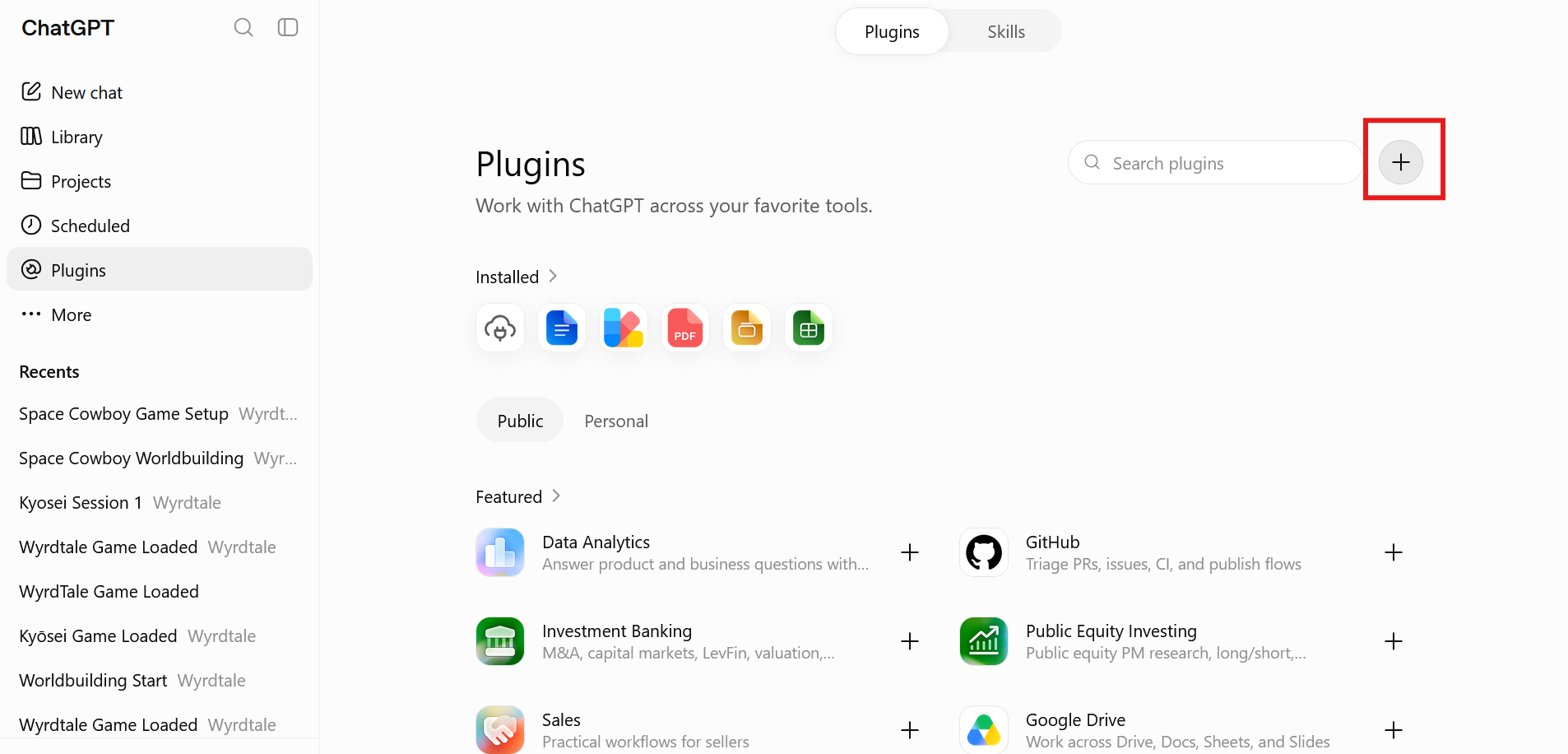
  1. Open Plugins and click the + button beside Search plugins
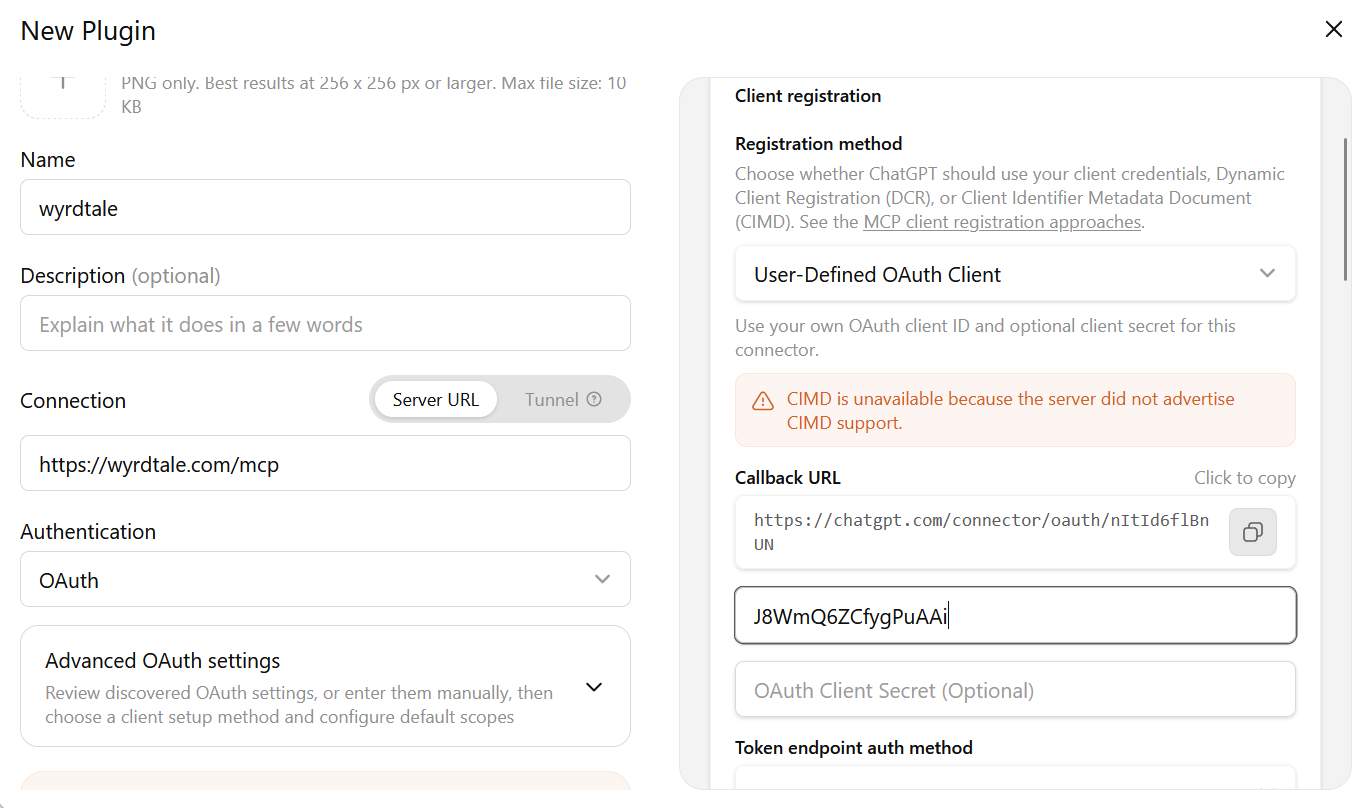
  2. Enter https://wyrdtale.com/mcp as the MCP server URL and choose OAuth
  3. Open Advanced OAuth settings, choose the preconfigured/manual client option, and enter client ID J8WmQ6ZCfygPuAAi
  4. Leave the client secret blank, connect, and sign in through Clerk
  5. Start a conversation and enable WyrdTale

The ChatGPT client ID is a public PKCE identifier, not a password. Do not use Dynamic Client Registration for ChatGPT yet—its current DCR flow omits a required scope.

Alternative: Claude Desktop via mcp-remote

Add this to your Claude Desktop config file (requires Node.js):

{
  "mcpServers": {
    "wyrdtale": {
      "command": "npx",
      "args": ["mcp-remote", "https://wyrdtale.com/mcp"]
    }
  }
}
Play with any MCP client

Any client supporting remote MCP servers can connect to https://wyrdtale.com/mcp

Recommended models: Claude Opus 4.7 or Opus 4.8 for Anthropic; GPT-5.6 for ChatGPT. In current testing, GPT-5.6 works best with WyrdTale. Any capable MCP agent can connect.

Pin the Operating Guide

WyrdTale's Game Master runs from an operating guide. Pin it in a Claude Project and Claude keeps it loaded across long sessions—even after hours of play fill the context window. This is the recommended way to play.

  1. Download the guide below (current version v22).
  2. In Claude, open or create a Project (claude.ai → Projects).
  3. Add the downloaded file to the Project's knowledge.
  4. In that Project, enable the WyrdTale connector and say “start a new game”.

⬇  Download the guide (v22)

At the start of play the GM looks for the line WYRDTALE GUIDE v22 in your Project. If it ever reports the guide is missing or out of date, download it again here and replace the file in your Project knowledge.